The 45-Minute Standup (And the 5-Minute Fix)
483 words · 3 min read

By Archie Cowan
Senior Prototype Developer for AWS global and strategic customers, former ITHAKA/JSTOR Chief Architect. Generative AI builder. Aspiring to do everything.
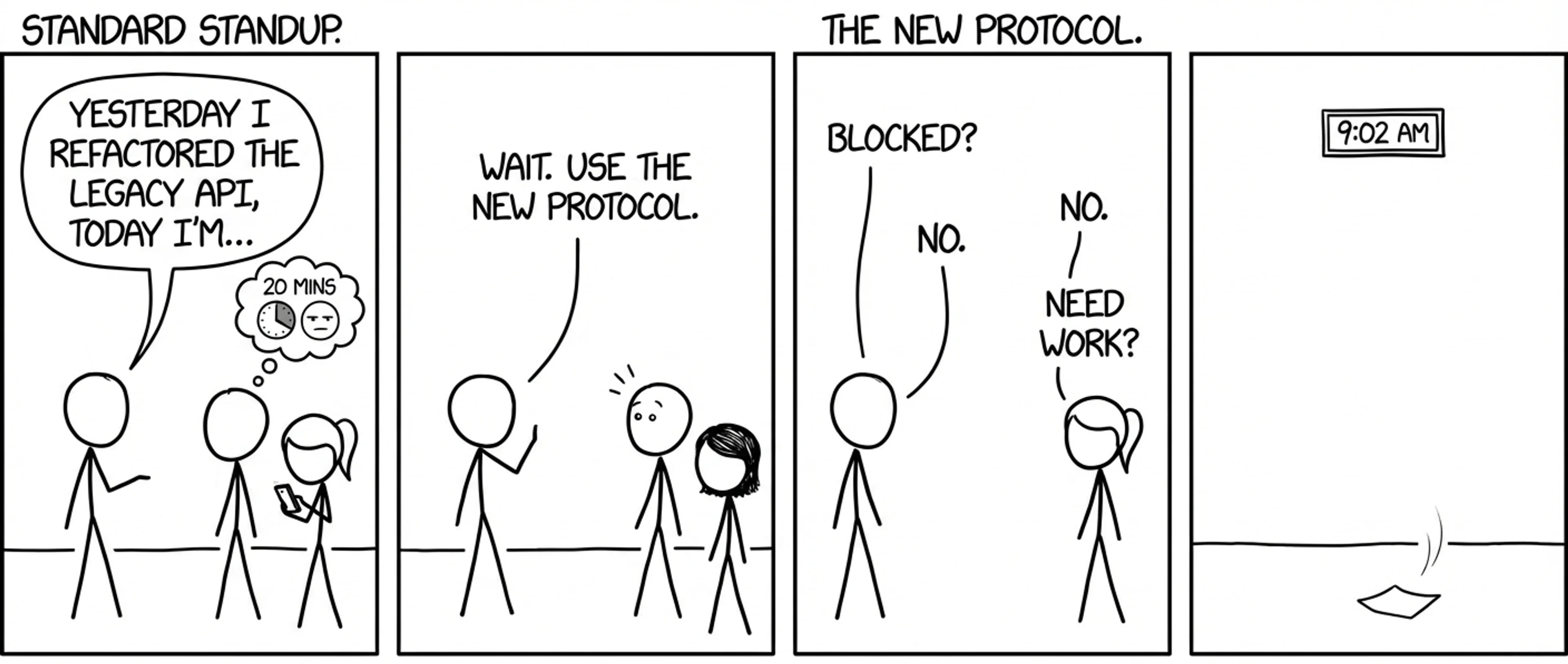
What would you do with 2-4 extra hours every week?
That's what's hiding inside your 45-minute standup. Not in some productivity hack or time management trick — just in running the meeting the way it was actually designed to work.
I've been in thousands of standups over the years. I've been the guy who overshared and took too much time. I've been the leader who hijacked the meeting for status updates. I've been the person tuned out on my phone while two people had a planning session that should have happened yesterday.
Here's what I finally realized: standup isn't broken because people talk too much. It's broken because it's doing a job it was never meant to do.
Today, when I look at it from a systems perspective, standup is an adaptation mechanism. It exists to catch what planning missed — someone who's stuck, someone who can't find work. It also gives the team a moment of situational awareness — a quick pulse on where everyone is.
When planning is weak, there's too much to adapt to. The standup expands to fill the gap. That's how a 5-minute check-in becomes a 45-minute planning session.
Two questions: Are you blocked? and Do you have something to pick up?
The answer isn't always "no, I'm good." Sometimes it's "I'm blocked, but Chirag is helping me right after this" or "I need work, David's going to point me to something after standup." The key is that the connection is made — the conversation happens later.
If the answer to both is "no, I'm good" — standup is done. The whole point is to surface problems fast so the right people can connect after the meeting, not during it.
But here's the thing most teams miss: if blockers and "I don't have work" come up constantly, that's not a standup problem. That's a planning problem. Standup is just showing you the symptom.
Five minutes. Not joking.
I've seen this work with two-pizza teams in a room. I've seen it work with dozens of people across three cities on a video call. The size doesn't matter — the discipline does.
If you can't get there yet, that's useful information. It means your planning needs work, and standup is telling you exactly where.
Want to try it with your team? Start with a retro conversation. Not "how do we make standup shorter" — that's treating the symptom. Instead: How can we improve our planning so that standup finishes in 5 minutes or less?
That question shifts the focus from the meeting to the system.
One caveat — if there's no interest in changing, don't force it. Changing how people work only sticks when they want it to stick. You can't optimize a process people aren't ready to let go of.
Play the long game. Wait for a moment when the team feels the pain — a sprint that went sideways, a week of 45-minute standups that left everyone drained. Then connect the fix to something they already care about: shipping faster, fewer interruptions, getting time back.
The 5-minute standup isn't a rule to enforce, it's feedback. It's a signal that your system is working.
© 2026 Archie Cowan