AI Coding Tips: Stop Generating, Start Translating
901 words · 5 min read

By Archie Cowan
Senior Prototype Developer for AWS global and strategic customers, former ITHAKA/JSTOR Chief Architect. Generative AI builder. Aspiring to do everything.
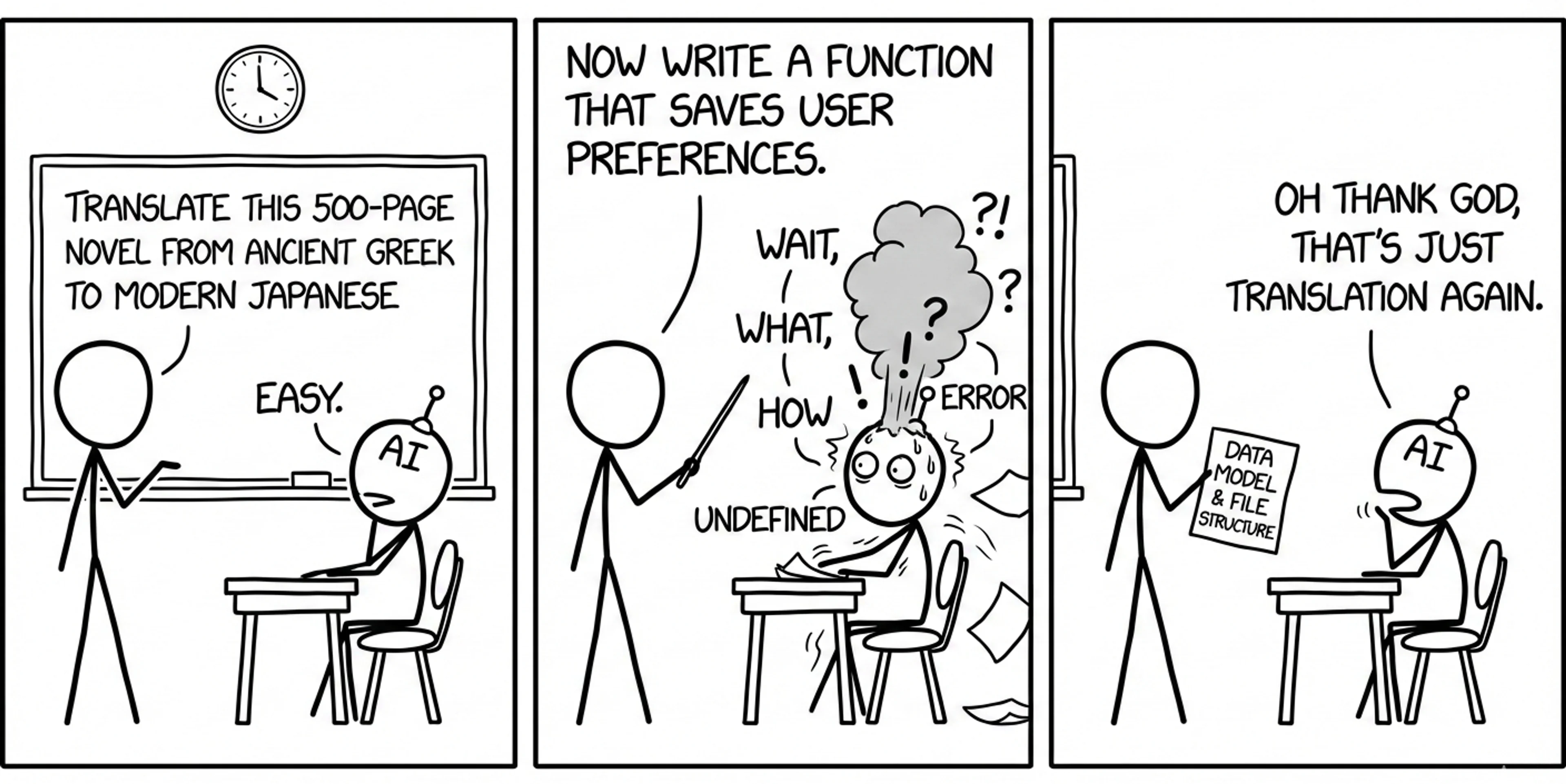
My AI assistant was useless for the hard part of my last project. Then it built the rest in a fraction of the time. The difference wasn't the AI—it was what I was asking it to do.
I was building something pretty niche—probably the most niche project I've ever worked on. The core of it was new to me and not something I could just reference on the Internet. On the core pieces, AI was pretty useless. Not for lack of trying. I used many if not most of the tactics I've shared in my posts on ai coding.
I had to work the good old fashioned way. Work in a notebook, design a library and determine the inputs and outputs of the routines. Iterate them with my customer. I learned a lot about a new thing. It was fun. Perhaps if I wasn't so new to the domain, I could have described what I needed more effectively to an AI assistant.
But then I needed to turn what was just a library into a holistic piece of software, running in the cloud, user interface, the whole kit. This is where my AI assistant helped me create like pouring gasoline on a fire.
At the beginning I lacked a core model of what I was doing and I was honestly learning as I progressed through a new domain. But, once that was created, I had a solid set of data models and procedures. Now I had a reference for the rest to come.
This isn't a coincidence. The Transformer architecture behind these AI assistants was literally built for translation—English to German, German to French. The breakthrough paper was called Attention is All You Need. Later, researchers discovered that if you make these models big enough, they can translate between almost anything given just a few examples in your prompt.
Hehe, the abstract of Language Models are Few-Shot Learners has this sentence:
Finally, we find that GPT-3 can generate samples of news articles which human evaluators have difficulty distinguishing from articles written by humans.
Cry 'Havoc!', and let slip the dogs of war! This was two years before ChatGPT.
Therefore, my core models weren't just documentation—they were the source language. With them defined, I basically had the prompts ready to build the rest of my application.
- I quickly created the scaffolding for the packages I wanted.
- My application model defined all the inputs and outputs that would be needed to interact with it throughout the application.
- My talented designer colleague gave me a colorscheme and layout styleguide.
- I knew how I wanted to deploy the application in AWS with CDK.
The pieces fell into place rather quickly at this point. These are translation problems. Not German to English, but given some APIs, a styleguide, and my web framework preferences, AI produced exactly what I wanted in a fraction of the time it would have taken me.
Translation Patterns That Work
Once I started thinking in translations, prompting stopped feeling like negotiation. I wasn't convincing AI to understand me—I was handing it a source and a target.
Scaffolding + Requirements → Package
- Scaffolding provides the target language structure
- Functional requirements provide the source intent
- AI translates between them into working packages
Working Prototype → Production System
- Notebook code + scaffolding → API implementation
- The prototype shows what you want, scaffolding shows how you structure it
- AI handles the translation between informal and formal code
Progressive Translation Chains
- Domain knowledge + scaffolding → data model
- Data model + desired storage patterns → CRUD API
- CRUD API + UI framework choice + style guide → user interface
Each step translates the previous output into the next layer of abstraction.
Reusable Guides as Translation Templates
- Take a reusable implementation guide
- Layer on your specific change request
- AI translates the general pattern to your specific needs
Refactoring as Translation
- Well-described inputs/outputs + messy implementation + target structure
- AI translates from "what it does" to "how it should be structured"
- Your working code proves the logic, scaffolding defines the target architecture
The Expert Privilege Problem
A recent post by Antirez on his success with AI coding Redis internals highlights something important: domain expertise dramatically improves translation quality. When you deeply understand both the source (what you want) and target (how systems work), AI becomes incredibly effective.
But many developers struggle because they lack either:
- Clear mental models of what they want to build
- Deep understanding of their target architecture
- Experience recognizing when AI translations are wrong
The translation metaphor helps here: you need to be fluent in both languages—what you want and how you build it.
I saw this in the project I was telling you about. I didn't have a clear mental model of what I wanted to build at first. I didn't have deep domain expertise. But once the effort reached cloud and web development stages, I could articulate exactly what I wanted and had the core model to reference.
Setting Up the Chain Reaction
Here's the thing about translation tasks: they compound. Your data model becomes the prompt for your API. Your API becomes the prompt for your UI. Each layer you nail gives AI more to work with on the next one.
The first translation is the hardest. After that, it's downhill all the way.
Where do you like to start? What's the first artifact you create that makes everything else easier?
© 2026 Archie Cowan